
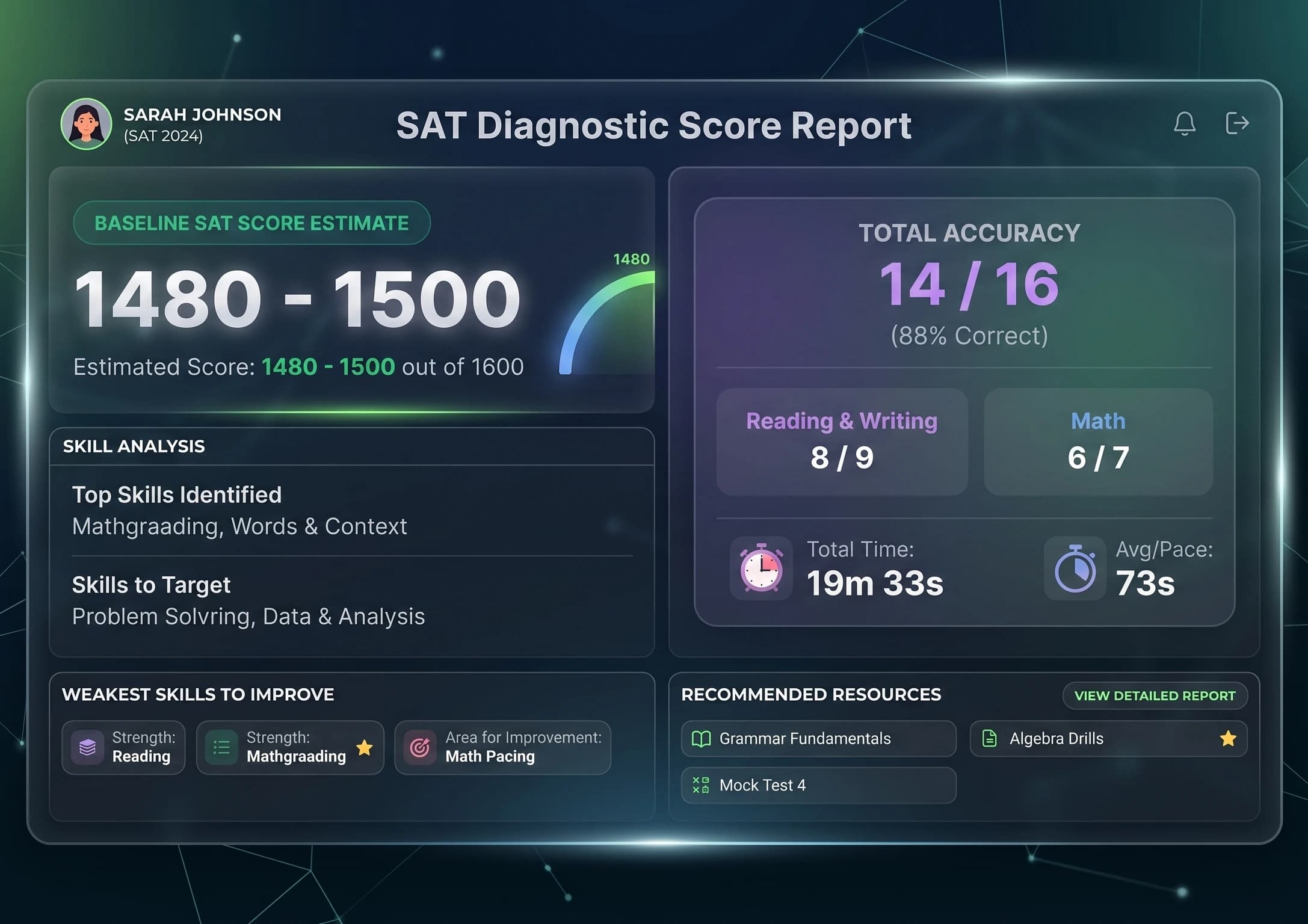
What is an SAT diagnostic test?
An SAT diagnostic test is a fast baseline assessment taken before formal test preparation to measure student proficiency across Reading, Grammar, Vocabulary, Algebra, and Geometry. The test identifies specific content weaknesses, calculates a composite score prediction (400 to 1600), and provides section scores (200 to 800) for admissions planning.
Unlike full-length practice exams used to build testing endurance, a 20-minute diagnostic test focuses on assessment speed. The test evaluates question-level accuracy against data from 1,000s of previous test attempts to predict official exam performance. High school students, tutors, and counselors use diagnostic results to compare readiness against the PSAT/NMSQT or ACT. For quick concept drills, review our SAT Vocabulary Flashcards.
How does adaptive testing work on the Digital SAT?
Adaptive testing on the Digital SAT measures student ability by adjusting the difficulty of questions in the second module based on performance in the first module. Both the Reading & Writing section and the Math section contain two modules.
+------------------+      High Accuracy      +-----------------------+
|   Module 1       | ----------------------> | Module 2 (Harder)     |
| (Mixed Questions)|                         | (Unlocks Score 800)   |
+------------------+                         +-----------------------+
         |
         |                Lower Accuracy     +-----------------------+
         +---------------------------------> | Module 2 (Easier)     |
                                             | (Score Capped ~600)   |
                                             +-----------------------+
Students who perform accurately on Module 1 route to a harder Module 2, unlocking section scores up to 800. Students with lower accuracy route to an easier Module 2, capping maximum section scores around 600. Taking an adaptive diagnostic test ensures students experience this two-stage routing structure used in the official College Board Bluebook application. You can also test on our web-based Digital SAT Bluebook Alternative.
What skills are analyzed in an SAT diagnostic test report?
An SAT diagnostic test report analyzes student performance across five core subject domains in Reading, Writing, and Math. Each domain maps directly to the official College Board Digital SAT curriculum.
| Exam Section | Diagnostic Skill Domain | Official Domain Weight | Tested Concepts & Tools |
|---|---|---|---|
| Math | Algebra | ~35% (13–15 Qs) | Linear equations, systems of equations, linear functions, inequalities |
| Math | Geometry | ~15% (5–7 Qs) | Right triangles, trigonometry, circles, volume, Desmos calculator |
| Reading & Writing | Reading | ~26% (12–14 Qs) | Information & Ideas: main idea, command of evidence, inference |
| Reading & Writing | Grammar | ~26% (11–14 Qs) | Standard English Conventions: sentence boundaries, modifiers, clauses |
| Reading & Writing | Vocabulary | ~28% (13–15 Qs) | Craft & Structure: words in context, text structure, purpose |
Each domain receives a percentage accuracy score in the performance report. Students can explore full topic breakdowns in our comprehensive Digital SAT Curriculum Guide or drill questions in the SAT Question Bank.
How is an SAT diagnostic score report generated?
An SAT diagnostic score report calculates composite scores (400 to 1600) and section scores (200 to 800) by analyzing question difficulty, response accuracy, and per-question pacing speed. The scoring engine compares student performance against statistical models built from 1,000s of test attempts.
| Composite Score (400–1600) | Section Score (200–800) | Percentile Rank | Target Admissions & Prep Goal |
|---|---|---|---|
| 1350 – 1600 | 680 – 800 | Top 10% (90th+ Percentile) | Highly Selective Colleges & National Merit |
| 1200 – 1340 | 600 – 670 | Top 25% (75th+ Percentile) | Competitive State Universities & Merit Scholarships |
| 1050 – 1190 | 525 – 595 | Average (50th–74th Percentile) | Standard Regional College Admissions |
| Under 1050 | Under 525 | Growth Needed | Foundational Skill Building & Pacing Drills |
According to benchmark metrics in our SAT Score Benchmarks Guide, scoring above 1350 places a student in the top 10 percent of test takers nationwide. Official practice from Khan Academy Official SAT Practice provides additional skill reinforcement.
How do you turn diagnostic test results into a personalized study plan?
A personalized study plan uses diagnostic performance reports to schedule targeted practice drills on high-yield topic weaknesses. Rather than re-studying familiar material, students focus practice hours on low-accuracy domains.
- Identify High-Impact Skill Gaps: Group incorrect diagnostic questions by domain (e.g., Geometry vs Grammar).
- Review Pacing Insights: Analyze seconds spent per question to eliminate time bottlenecks on hard Math or Reading items.
- Set Daily Topic Targets: Complete 15 targeted practice drills daily in your lowest-scoring category using the built-in Desmos graphing calculator.
- Track Score Growth Weekly: Take short adaptive mini-tests every 7 days to verify score improvements.
Frequently Asked Questions
How long does the free SAT diagnostic test take?
How accurate is the 20-minute SAT diagnostic score prediction?
Does the SAT diagnostic test include the Desmos calculator?
Is the SAT diagnostic test free for high school students, tutors, and parents?
How does an SAT diagnostic test compare to PSAT/NMSQT or ACT prep?
Take Your Free SAT Diagnostic Test Now
Ready to find your baseline score and evaluate your Digital SAT readiness? Create a free account to launch our 20-minute adaptive SAT Diagnostic Test, complete with instant score prediction, pacing insights, and domain performance reports.