
Is the Digital SAT Really Adaptive? What Every Parent Needs to Know
TL;DR GUIDE FOR STUDENTS & PARENTS
"For most students, the Digital SAT is essentially a linear test. Your scores are sticky and won't change overnight — this is exactly why the College Board validates scores for 5 years. If your student is consistently scoring 560+ in both sections, they will trigger the harder modules. If you aren't sure of their current level, take a Bluebook test or try a free adaptive practice session on MyCollegeBook to see which track they'll likely encounter on test day."
If you're worried about the SAT "changing difficulty" while your student is taking it, you're not alone. The new format is confusing, but we're here to demystify it without the technical jargon.
When did the SAT become adaptive?
The transition to a "Digital, Adaptive" format was a staged global rollout by the College Board. For international students, the change officially started in March 2023. For students in the United States, the final paper SAT was administered in December 2023, and the Digital SAT became the only option starting in March 2024.
Source: College Board Official Newsroom
How is the Digital SAT adaptive?
Unlike "item-adaptive" tests (like the GRE or GMAT) which change difficulty question by question, the Digital SAT is section-adaptive (or "stage-adaptive").
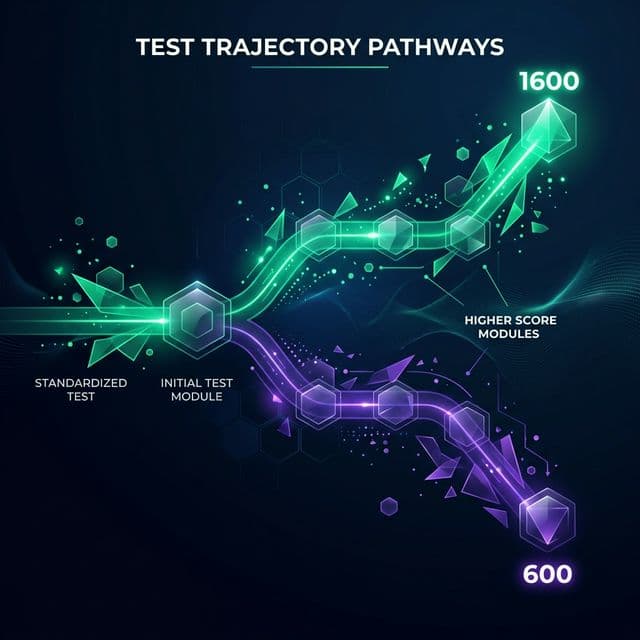
A visual representation of how the SAT algorithm splits into 'easy' and 'hard' modules based on accuracy.
Each section (Reading & Writing, and Math) is split into two modules. Every student takes an identical Module 1. The test's software then analyzes your performance in real-time to decide if your Module 2 should be the "Standard/Lower" track or the "Advanced/Higher" track.
Does the SAT have adaptive questions?
Technically, no. The questions themselves don't change while you are looking at them. The "adaptation" happens in the transition between modules. You are served a pre-defined set of questions in Module 1, and based on your accuracy, you are served a completely different pre-defined set of "Hard" or "Easy" questions in Module 2.
The "15+ Rule": How the SAT Decides Your Score
One of the most common questions we get is: "How many do I need to get right to get the 'Hard' module?"
Based on our data from tracing thousands of student attempts, the magic number is about 15 out of 22 questions in the first Math module. This is what we call the 15+ Rule.
- Math: Get 15–16 questions right in Module 1 to unlock the 700+ score range.
- Reading & Writing: You typically need about 19 out of 27 correct to cross the hurdle.
Why this matters to you: If your student is scoring in the 1450+ range, they are likely already clearing these hurdles effortlessly. For high-achievers, the SAT is effectively a normal, linear test.
How does SAT adaptive scoring work?
The SAT uses a system called Item Response Theory (IRT). In this system, questions aren't just "1 point each." Harder questions carry different statistical "weights" than easier ones.
By serving you a harder second module, the test allows you to earn points that simply aren't available in the easier module. This is why a student who gets 5 wrong in the hard module will still outscore a student who gets 0 wrong in the easy module.
Source: Wikipedia: Item Response Theory
Is the adaptive SAT harder?
Subjectively, it feels shorter and more focused, which many students prefer. However, it is "harder" in the sense that the stakes for early mistakes are much higher.
Because the first 30 minutes (Module 1) determine whether you can even *access* the 700+ score range, a few careless errors early on can "cap" your potential before you even see the second half.
How is the SAT standardized if it's adaptive?
This is a major concern for parents. If two students take different modules, how is the test fair? The answer is Equating.
The College Board uses complex statistical models to ensure that a 720 on Monday's test (with a specific set of questions) is exactly the same as a 720 on Saturday's test. The "difficulty" is baked into the score conversion. An adaptive test isn't about making the test easier or harder; it's about measuring your level faster and with fewer questions.
How is an adaptive test fair?
Legally and logically, an adaptive test is actually more fair than a linear one. In the old paper format, a high-scoring student wasted 40 minutes answering "easy" questions that didn't help distinguish them from a mid-level student.
In the adaptive format, the test "finds" your ceiling quickly. It gives every student multiple opportunities (via Module 1) to "trigger" the harder content. Fairness is guaranteed because everyone starts on the same level playing field in the first module.
Is the Bluebook SAT adaptive?
Yes. The official Bluebook™ app provided by the College Board uses the exact same section-adaptive logic as the real exam. If you take a practice test in Bluebook, your Module 2 will shift difficulty based on your Module 1 score.
Are SAT practice tests adaptive?
It depends on the provider. Most "PDF" practice tests or "quiz" sites are not adaptive—they are static.
To truly prepare, your student must use a Digital Simulator (like Bluebook or MyCollegeBook) that actively blocks you from the high-score module if you miss the 15+ hurdle in the first section.
How do I know which module (Hard or Easy) I got?
The test won't display a notification. However, at MyCollegeBook, we’ve identified two tell-tale signs (and a deeper data analysis on Module 2 anxiety):
- The "Desmos" Test: If Module 2 starts with questions that *require* the graphing calculator to solve within 60 seconds, you are likely in the Hard module.
- The Reading Shift: If your second module in Reading & Writing starts with 3 or 4 dense "Science" or "Literature" inference questions back-to-back, you've hit the Hard track.
Does the digital adaptive test adjust question difficulty?
No, it adjusts Module difficulty. It is important to remember that within a single module (say, the 22 questions of Math Module 1, drawn from the standardized curriculum), the questions do not change difficulty based on your previous answer. You can go back and change your answers within a module. The "adjustment" only happens once you submit Module 1 and the computer prepares Module 2.
How do adaptive SAT tests work on online learning apps?
Many apps "claim" to be adaptive but are actually just serving random sets of questions. A true adaptive simulator must use the College Board's official "Scoring Tables" which provide specific weights to every question. At MyCollegeBook, our platform uses these exact tables to trigger the module switch at the 15+ correct-answer threshold.
Does the adaptive format change my prep strategy?
Yes — and the main change is "Careless Error Management."
In the old SAT, a mistake at the beginning of the test hurt just as much as a mistake at the end. In the new Digital SAT, a mistake in Module 1 is catastrophic because it can "lock" you out of the 700+ range.
Our Strategy for Parents:
- 1.Tell your student to slow down for the first 15 questions. Treat them with the same respect as the hardest questions.
- 2.Focus on Desmos Mastery. The calculator is their best friend in the Hard Module, but many students "forget" how to use it under pressure.
Strategy for Parents: Managing Anxiety vs. Reality
The word "Adaptive" makes the test sound like a sentient machine trying to "beat" your student. In reality, it is just a more efficient way to measure their skills.
**The most important thing you can do:** Have them take a full-length, browser-based adaptive test. Once they see the interface shift and realize they *can* handle the harder module, the anxiety disappears and they can focus on the content.
Will they get the Hard Module?
Stop guessing. Use our true-to-life simulator to see which track your student will likely trigger on test day.